The first week of 2026 has officially set the stage for the “Year of the Agent.” While the world was celebrating the New Year, the AI industry was busy shifting from simple chatbots to autonomous systems that don’t just talk—they do.
1. The Global Rollout of Gemini 3 Flash
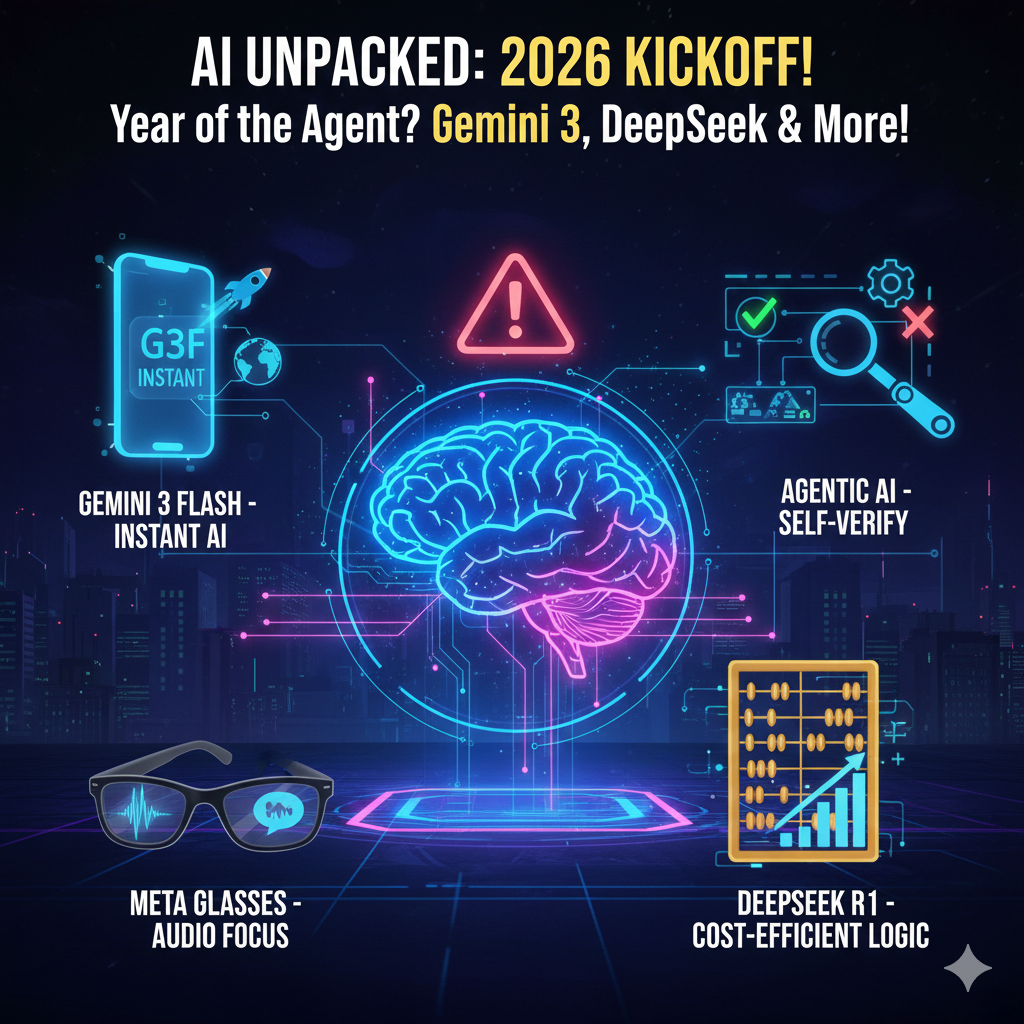
Google kicked off the year by making Gemini 3 Flash available globally across Search and its mobile ecosystem. This model is designed for near-instant response times, effectively ending the “waiting game” for AI interactions. It’s also the engine behind the new Nano Banana Pro, bringing frontier-level intelligence directly to on-device hardware.
2. DeepSeek R1 Shakes the Market
The competitive landscape took a massive turn as China’s DeepSeek R1 model went viral. It’s a high-performance reasoning model that matches the logic capabilities of top-tier Western models but at a fraction of the cost. This has sparked a “reasoning war,” forcing other labs to accelerate their development of models that can “think” before they speak.
3. The Shift to “Agentic” AI
The biggest trend of the week is the rise of Agentic AI. We are moving past AI that answers questions to AI that manages workflows. New “self-verification” features were introduced this week, allowing agents to detect and fix their own mistakes before a human ever sees the output.
4. Hardware Evolution: AI Smart Glasses
Meta and Google both made waves in the wearable space. Meta’s latest update introduced “Conversation Focus,” using AI to solve the “cocktail party problem” by isolating and amplifying voices in noisy rooms. Meanwhile, rumors are heating up about Google’s 2026 relaunch of Gemini-powered smart glasses.
5. Ethical & Safety Check
It wasn’t all celebrations. The AI Safety community issued a “Code Red” warning, with experts like David Dalrymple suggesting that rapid advances are outpacing our ability to control powerful systems. Meanwhile, Elon Musk’s Grok AI faced backlash over safety lapses in its image generation safeguards.